To Do

 https://groups.yahoo.com/neo/groups/hunter19/conversations/messages/20
Change the backstay to pully system to make it adjustable and so it can tension
the rig for the up wind legs
Fitted quick release jammers on the coach roof bringing all the halyards, spinaker up/down haul
back to the cockpit.
Removable toe strap in the cockpit fitted for a windy day (although one does need to remove the
guard rails to aid leaning out!)

Option 1 – Hull is being cleaned, sanded and so on. After this she is being covered with 5 layers off epoxy coat, and 6 layers off AWL grip 2c. paint 
Option 2 – Rubbed down with wet and dry.
Rubbed down with steel wool.
Rubbed down with white spirit (Thinners)
I coat of blue grey Prekote brushed on. No thinners added. He said it
went on like glue.
First coat of Brightside rolled and brushed on. He used a little
amount of thinners. He also used a mini roller and the sheeps wool
type, not the foam type.
Second coat Brightside again with thinners added. Same rollers.

Tinned wire as this does not corrode.

Master & Mast  isolator switch.

Solar panel diode built in to prevent nigh-time discharge.

NASA Clipper instruments,  “DUET” which combines an echo sounder and log in the same unit. The depth transducer also sits inside the boat in a well of nut oil (this is supposed to be better than bonding it to the boat, however it can be messy!). Hole in the boat for the log!
Transducer just aft of the keel a few inches out from the centre line

Spinnaker using a GRP launching funnel and sock on the pullpit (a common feature on ullswater) the pole is stowed on the boom. Forestay rig tension is adjusted by a ‘Muscle-Box’ mounted on the
deck. The headsail is sheeted in by hand for speed via turning block (no winches) Custom made aluminium foot-pegs in the foot well for stability when she is healed, an aluminium tiller extension and an extra aluminium ‘King-post’ mounted dirctly under the mast foot to cope with the extra rigg tension for racing. She also has a cascade sysem pulley to tension the backstay and the same for the babystay.
  
Rub it down and priming yourself, 2 coats , final rub down working thro’ the paper grades from 180 to 400 (white) – 600 (darker colours) then get a one man band sprayer in, i know one, very reasonable,
with a poly tunnel or make shift gazebo/tent he could properly do it in the garden
we are not talking large areas, only aprox 0.6m waterline to sheerline ! x 12m

Under Sail

  1. Leave the bottom washboard in place and tied/secured down while under sail – you never know when you are going to catch a rogue wave in the cockpit, or get knocked down.
    • The original H19 wont have a self draining cockpit and a self bailer wont help until you are moving at speed.
  2. a
  3. b
  4. c
  5.  
 

Ventilation

Solar powered motor assisted vent:
Careful to site it where you wont step on it and break it and also place it where it wont get too many big green ones breaking right over it – while they are very water resistant to blown’ spray, I don’t think they are intended to be frequently submerged and may let in water if they are.

You can screw them closed while sailing.
Stainless steel mushroom type vent just to the front of the mast on the slope.

Mast Rigging

Mast rigging, or standing rigging as it’s known, comprises the backstay and the forestay to keep the mast in place longitudinally, plus the masthead ‘cap’ shrouds together with the lower shrouds to secure it laterally.
But it’s not normally the stainless steel wire shrouds and stays that fail; it’s the fittings that are associated with them, particularly those used to attach the shrouds to the mast.
And most mast rigging failures are the result of poor maintenance or cheap fittings…


Primary mast rigging shrouds and stays 
It’s vital that the mast rigging is free to articulate at each end of the shrouds and stays to accommodate the natural flexing that will occur.

Otherwise, if misaligned or restricted in movement at all, stainless steel rigging will quickly fatigue and fail.
For this reason the lower ends of all shrouds and stays must be fitted with toggles.
Aloft, toggles are only required on the forestay (and cutter stay, if fitted) to take up the lateral movement caused by the headsail and staysail.
On multi-spreader rigs, discontinuous rigging terminates at the spreader ends rather than on deck.
As a result it uses less material and therefore reduces weight aloft, plus the better articulation also reduces metal fatigue and simplifies the job of tuning the rig.

Running Backstays

Fractional rigs and cutter rigs are normally associated with running backstays, a contrivance viewed with some disdain by many cruising sailors.
There are other ways of supporting these rigs – aft-swept spreaders and aft intermediate shrouds, but both give rise to other problems that you may feel outweigh any benefit:

  • Aft-swept spreaders limit the amount by which you can square off the main without chafing the sail on the spreader ends. Tuning the rig is also much more difficult;
  • Aft intermediates are only a few degrees off vertical, so to get any meaningful aft component of force they must be highly tensioned. This puts a lot of compression on the mast and additional load on the chain plates.

Mast Rigging Hardware

Through-bolted tangs and eyes are the most secure method of attaching shrouds to the mast and T-bars and stem ball probably the least.

Rigging screw that tensions the shrouds and stays on a sailboat

Alloy castings – as often seen in masthead assemblies, goosenecks, spreader sockets and boom kicker attachments – are always suspect. There may be voids or other defects within, which are totally invisible from the outside. For these fittings, welded fabrications are more reliable than castings.

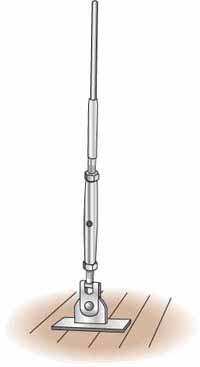
The rigging screw, which tensions the shrouds and stays

Rigging screws – or turnbuckles as our American friends call them – are used to tension the standing rigging, although hydraulic rams may be used on the backstays of larger vessels.
Very often the central body part and the stud ends are machined from stainless steel, which is not quite as sensible as it may first seem.
Turning these under high loads can cause the threads to gall and seize together, but this risk can be avoided by using either all bronze components, or a bronze body and stainless studs.
Some years ago I was sailing my Nicholson 32 single-handed from Moraira on the Spanish Costa Blanca to Ibiza, one of the Balearic Islands in the Mediterranean. Conditions were perfect, the sun was shining, not a cloud in the sky and Jalingo II was bowling along nicely.
I was idly watching my mate ‘Arry’ doing his thing. ‘Arry’ being the Aries self-steering gear I hasten to add. A periodic glance ahead and something shiny on the foredeck caught my eye. What was it? Oh my God, a clevis pin!
A most urgent inspection took place. The rig was still there, which was a good sign. The windward shrouds were taut and there was nothing flapping on the leeward side. A close inspection at deck level revealed that everything was as it should be and the binoculars confirmed a similar situation aloft.
Much relieved, I could only assume that a higher authority had decided I was having far too much fun. Or, maybe it had fallen from my spares kit. Either way it reminded me just how much the rig depends on these small items. Love your clevis pins and protect them.

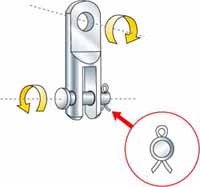
A toggle, which allows ensures the alignment of the rigging screw on sailboat shrouds and staysThe toggle, which provides alignment on both axes

Clevis pins are designed for shear loads, not bending, so toggles must fit snugly around them. Left to their own devices they will wriggle out, with calamitous results, so they must be securely retained.
Split pins – cotter pins in the USA – are good provided they’re installed correctly. The temptation is to open them too wide.
Split rings are a poor substitute. If subjected to chafe – a flogging sheet for example – they’ll deform, rotate and will very probably fall out – whereupon, to quote an old English nursery rhyme, down will come baby, cradle and all.

Eliminating Radio Interference


Shut off the reefer when operating the SSB
 
The most effective way to reduce emissions from the power leads is to use shielded cable.

  1. Keep lengths to the minimum.  
  2. Twist power leads and apply grounded shields 
  3. Run positive and negative supply lines together in the same runs,even if one of them could be made shorter 
  4. Avoid providing multiple ‘grounds’ to the same equipment. 
  5. Loop the power leads through proper ferrite torroids (not the clamp on styles) and use of capacitors before and after the torroids.

Any kind of switching power supply will cause RF noise and should be shielded. 
This includes the compressor and also the current drivers on led circuits. 
The pulse width modulator current drivers create RF noise for the same reason, short rise and fall edges on the pulses.

It is common practice to run Positive and Negative (aka ‘ground’) wires separately.
This creates a ‘magnetic loop’ that radiates Electromagnetic Interference that generates a signal in antennas.
Magnetic inductance is proportional to loop area.

Navigation Light Rules

Recreational boats operating at night are required to display navigation lights between sunset and sunrise.

Basic rules:

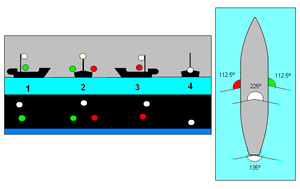
  1. Sidelights are red (port) and green (starboard) and shine from dead ahead to 112.5° aft on either side.
  2. Stern lights are white and shine aft and 67.5° forward on each side. (Thus, the sidelights and stern light create a full circle of light.)
  3. All-round lights are white and shine through 360°.
  4. Masthead lights are white and shine from 112.5° on the port side through dead ahead to 112.5° on the starboard side. They must be above the sidelights.
  5. Sailboats under power are considered powerboats.
  6. Sidelights may be combined into a single “bicolor” light.
  7. Powerboats less than 20m (65.7′) in length need to show sidelights, a stern light and a masthead light. Power vessels less than 12m may show a single all-round light in lieu of the separate masthead and stern lights.
  8. Sailing vessels less than 20m in length need to show sidelights and a stern light. These may be combined into a bicolor light and stern light, or a single tricolor light at the top of the mast. Sailing vessels under 7m must have an electric torch or lantern available for collision avoidance.
  9. Oar-driven vessels can show either the sailboat lights, or use the electric torch/lantern option.
  10. When anchored outside a special anchorage, power and sail vessels under 20m must display an all-round light. Vessels under 7m are exempt, unless anchored in a narrow channel or anchorage, or where other vessels usually navigate.
  11. Sailboats with sails up during the day, but which are also under power, must fly a black “steaming cone,” with its point downward, where it can be seen. When under power they must follow the rules of the road for powerboats.

Notes

  1. Boats under power under 40′ can substitute a single all-round light for separate stern and masthead lights 
  2. Boats under 65’7″ can substitute a single bi-color light for sidelights 
  3. Sail boats under sail under 65’7″ can substitute a tri-color light for separate sidelights and stern light.
  4. See our Anchor Ball

Definitions

      All-Round Light: White (32pt/ 360°)
      Masthead Light: White (20pt/ 225°)
      Sidelights: Red (10pt/ 112.5°) & Green (10pt/ 112.5°)
      Stern Light: White (12pt/ 135°)

Boat Light Template

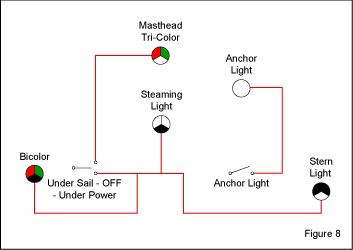
Navigation Light Switching for Vessels Under 20 Meters

The possible switch configurations for navigation lights vary greatly depending on the vessel size, type, and purpose. This article addresses the most common configurations for smaller vessels.
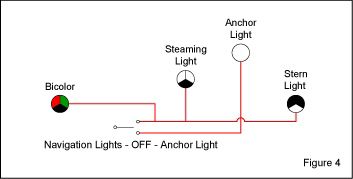
ABYC standards state that one switch, or position of a switch, will turn on all of the navigation lights required for the vessel while underway. Another switch, or position of a switch, will turn on the anchor light. This allows the use of either 2 switches or a 3 position switch with one off position.
The most common configurations of lights are:

  1. A bicolor light with an all-round (360°) white light
  2. A bicolor light with a 135° stern light and a 225° masthead light and a 360° anchor light
  3. Two sidelights with an all-round (360°) white light
  4. Two sidelights with a 135° stern light and a 225° masthead light and a 360° anchor light
  5. A masthead tri-color light with a 225° masthead light and a 360° anchor light

these can be broken down into 3 combinations:

    1. A bicolor or two sidelights and an all-round white light
    2. A bicolor or two sidelights with a 135° stern light and a 225° masthead light and a 360° anchor light
    3. A masthead tri-color light, a bicolor or two sidelights, a 135° stern light, a 225° masthead light, and a 360° anchor light

    Combination Navigation Lights Anchor Light Steaming Light Figure #
    A DPST SPST * 1
    A DPDT * * 2
    B (Power Boat) SPST SPST * 3
    B (Power Boat) SPDT * * 4
    B (Sailboat) SPST SPST SPST 5
    B (Sailboat) DPDT SPST * 6
    C SPST SPST SPST 7
    C SPDT SPST * 8

    *included in navigation lights switch
    **includes navigation lights excluding masthead tri-color

    SPST – Single Pole Single Throw
    SPDT – Single Pole Double Throw (Center Off)
    DPST – Double Pole Single Throw
    DPDT – Double Pole Double Throw (Center Off)

    The following illustrations use a bicolor, but two sidelights can be substituted for it in the diagram. All of the double throw switches are “Center Off”.